Available in: English, Spanish, French, German, Japanese, Chinese, Italian, Portuguese, Korean, Russian, Dutch, Polish, Hindi, Arabic, Turkish, Indonesian, Thai, Vietnamese and Bengali.
A song is not
speech.
Music localisation means keeping a song's melody, rhythm, rhyme and the artist's voice intact, in a new language.Melody, rhythm, rhyme and voice all have to survive.
- 1
Pitch
A sung line has a fixed melody. Drift and it is out of tune.
- 2
Meter and syllable count
The new lyric must fit the same beats.
- 3
Rhyme and hooks
The stress must land on the beat, or the hook is lost.
- 4
Held notes and runs
Sustained vowels are the hardest part to adapt.
- 5
Mix separation
The vocal leaves and re-enters the mix cleanly.
What Moozz is not. Moozz doesn't make songs from a prompt. Every adaptation starts from a recording someone already made and owns.No songs from prompts. Only recordings someone owns.
Why adapt
your music?
Film and TV went global by dubbing. Music is next.
of watch time comes from other languages for YouTube creators who add dubbed audio.
YouTube, September 2025videos dubbed into other languages by YouTube in just six months.
YouTube CEO Neal Mohan, June 2025a year: growth in viewing of dubbed content on Netflix.
The Hollywood Reporter, 2019- 01
Reach listeners who never got the lyric
A song crosses a border as sound, not as meaning. An adaptation gives new listeners the song you actually wrote, in the voice they already recognise.New listeners get the song you wrote, in your voice.
- 02
Test a market before you spend on it
Touring, marketing and A&R in a new territory are expensive to start. Localisation works as market discovery: a language version produces real demand data first, from streams, saves and playlist adds.Real streams and saves before you spend on a territory.
- 03
Reactivate catalogue that stopped earning
Most catalogue is finished, paid for and exhausted in its home language. An adaptation gives it a second release in a market that has never heard it.Give it a second release in a new market.
- 04
Skip the re-recording
The traditional route is booking vocalists and re-cutting sessions, often with a different singer. Adaptation removes the session cost and keeps the original performance.No sessions, no new singer.
- 05
Keep the artist, not just the song
A re-recording is a different performance by a different singer, and the audience hears it. Keeping timbre, phrasing and delivery is what makes it feel like the artist.Same timbre, phrasing and delivery.
- 06
Add an asset, don't replace one
The adapted recording has its own ISRC and is reported separately, so it earns alongside the original. The original master is not altered.Own ISRC. Earns alongside the untouched original.
From master to
language version.
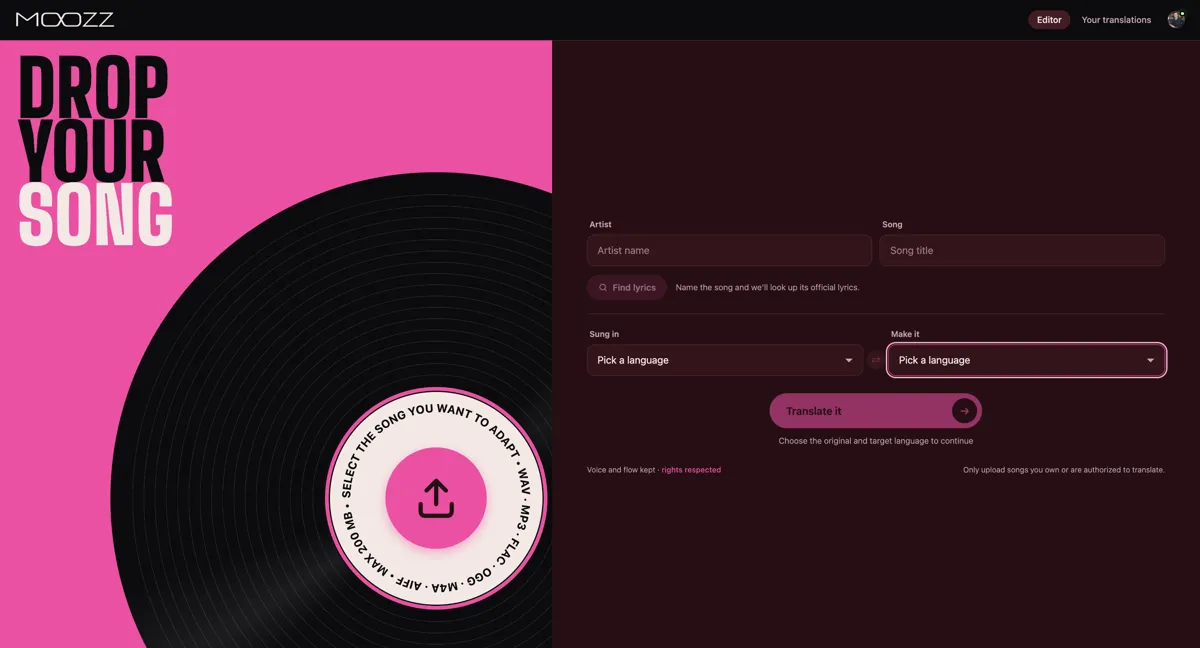
Drop in a finished master, name the song and pick the original and new language.Upload a master and pick the languages.
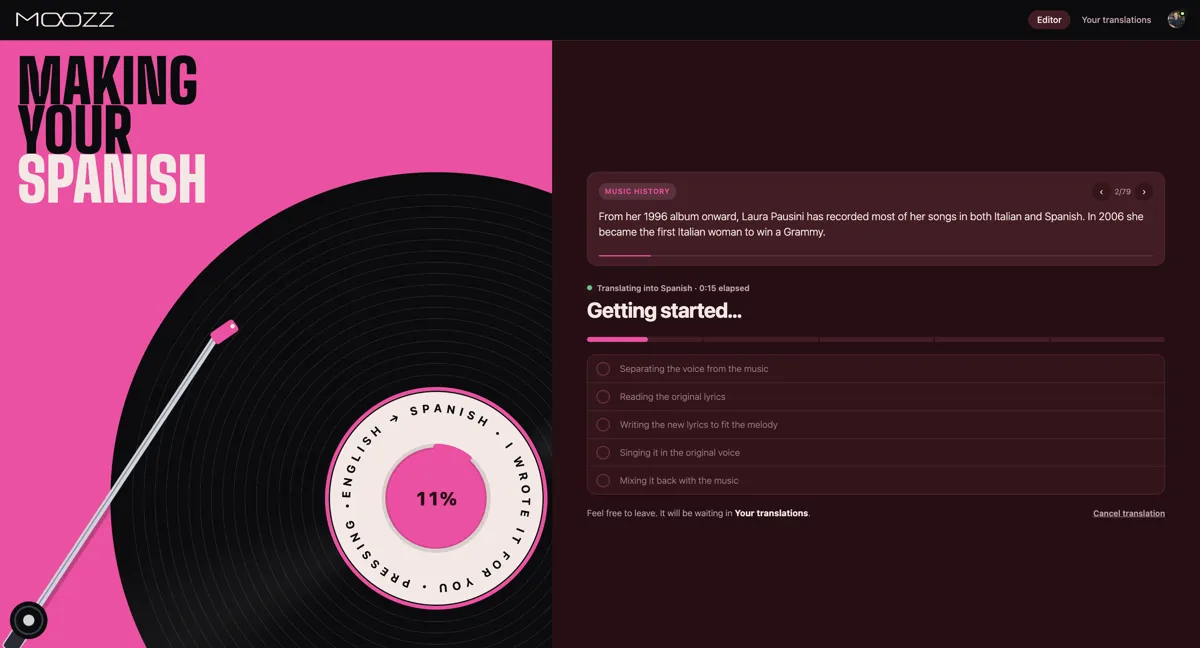
Processing runs in the cloud and progress is saved, so you can close the page and come back.Runs in the cloud. Close the page and come back.
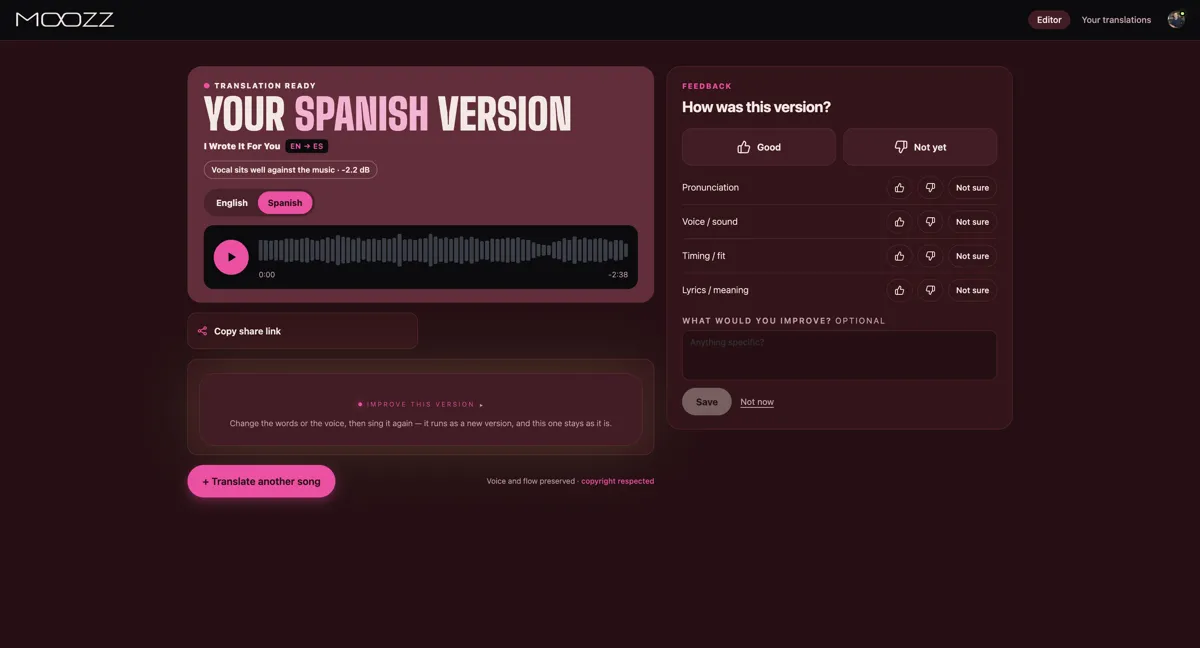
Switch between the original and the new language, and share a link.Compare both versions and share a link.
Go global.
From day one.
Try Moozz today with a song you own.